
Out by Nine: Interim Suspension and the Sentence That Matters Most
By Zachary Gaynor, Esq. · Last reviewed
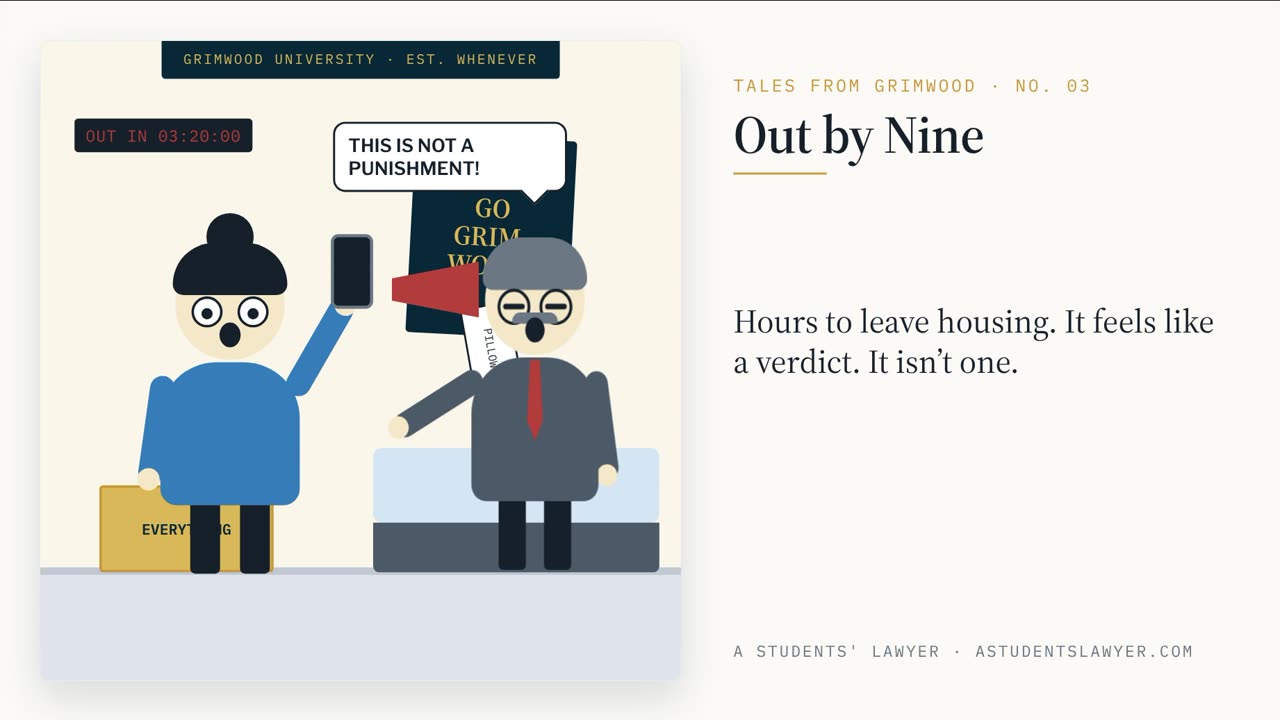
An interim suspension removes a student from campus, housing, or classes while an allegation is still being investigated. It is not a finding that you did anything. Most notices include a way to challenge the suspension itself, usually in one sentence near the end, often with a window of a few business days. That sentence is the most important one in the letter. The cartoon below shows how it gets missed.
What an interim suspension is
Schools use interim measures when they say a student’s presence poses a risk while a complaint is pending. The notice can bar you from housing, classes, dining, labs, events, or the whole campus, and often comes with no-contact directives. It usually takes effect immediately, and the deadline to leave housing can be the same day.
The notice will usually say the suspension is not a disciplinary sanction. In practice it can cost a semester, a clinical placement, a scholarship, campus employment, or visa status, before anyone has decided what happened.
The review sentence
Most conduct codes give a student some way to ask for review of an interim measure: a written request to the dean of students, a meeting with a conduct officer, or a short hearing. The window can be very short. If it passes, the suspension often stays in place until the full case is resolved, which can take months.
If the suspension is connected to a Title IX sexual-harassment allegation, federal rules require the school, before removing a student on an emergency basis, to carry out an individualized safety and risk analysis and to determine that an immediate threat to someone’s physical health or safety justifies the removal. The school must also give the student notice and an opportunity to challenge the removal immediately afterward. At public universities, constitutional due process also applies. At private schools, the school’s own written procedures control.
The first 24 hours
- Find the review deadline. Read the whole notice and the conduct code section it cites. Count business days, and write the date down.
- Follow the directives. Leave housing on time and obey no-contact terms, even if they seem unfair. A violation becomes its own charge.
- Do not explain yourself by text or social media. Messages to the other student, friends, or group chats can become evidence.
- Request review in writing, inside the window. Keep a copy and confirmation that it was received.
- Propose something narrower. Remote classes, a changed housing assignment, schedule changes, or a no-contact order alone may address the school’s stated concern without removing you entirely.
Why the review is worth asking for
A review request does more than ask the school to reconsider. It creates a written record that you objected, what you offered instead, and how the school responded. If the matter later reaches an appeal, an outside agency, or a court, that record matters. It also forces the school to state its reasons for keeping the suspension in place.
If you have received an interim suspension notice, read more on interim suspension, or tell me what happened. If the review window is open, say so when you write.
Zachary Gaynor, Esq.
A Students’ Lawyer · Student defense and education law · Boca Raton, Florida · Florida Bar No. 125534. I represent college, graduate, and professional students in disputes with their schools — in campus proceedings and in federal and state court — and I write every post here myself.
About me · How to choose a student defense lawyer · Tell me what happened
General information, not legal advice about your situation. Reading a post does not make you a client.
Facing this now?
Deadlines in these matters are often short. Reach out early and tell me what is happening.
Recent Posts
A campus decision can follow a student for years.
A boutique practice can be flexible in a way a larger firm often cannot. Depending
on the matter, that can take any of these forms.
From the very beginning
The earlier I'm involved, the more options stay open. I can step in at the first notice, charge, or letter — before a deadline closes or a statement is given — and help shape the matter from the outset.
Behind the scenes
Where a process limits an advisor's speaking role, I work in a consulting capacity — reading the policies, preparing you and your statement, and drafting submissions and appeals — without ever appearing.
Complex, high-stakes matters
Cases that cut across academic, disciplinary, civil-rights, and financial lines — the ones that don't fit a single box — are squarely the work this practice is built for.
Second opinions
If you already have counsel, or simply want another read before you act, I provide focused second opinions at a reasonable, agreed cost.
Ongoing counsel
For students, families, and advisors who want a lawyer on call as a situation develops, I'm available on an ongoing monthly basis.
Worked out to fit
The scope and the fee are discussed up front and structured to fit the matter. The goal is a practical arrangement that gets the situation handled.
The scope of any engagement and the fee are set out in a written agreement. Contacting the firm does not create an attorney–client relationship.